|
|
The Kenya Appeal |
|
|
|
 |
When we first arrived at Mombasa Airport we were obviously excited as we stepped off the plane and the heat struck us as though standing in front of an immense furnace. After clearing the airport and making our way to the coach that would take us on to our hotel we were overwhelmed by the politeness of the porters at the airport, falling over each other to have the opportunity to take our luggage to the coach. Once on the coach we set about our journey which was some 2 hours drive away. It took approximately 5 minutes into the journey to have some realisation that this beautiful tropical location was also a very tough place for many of the people that lived here. As you looked around while travelling through Mombasa, it wasn’t difficult to observe that hardly anyone appeared to have any kind of regular employment. |
| The roofing on many of the make shift structures was rusty corrugated iron; we were later to discover that they were the lucky ones. For the rest of our journey we sat there mostly quiet, realising at this point that many of the people were in need of a great deal of help. We watched people walking along the roadsides struggling to carry immense barrels of water. Further on down the road passing the odd village where a man would be sitting in a hut with a thatched roof selling this water from stand-up pipes jutting out of the ground at a cost of approximately two English pounds per refill. |
 |
 |
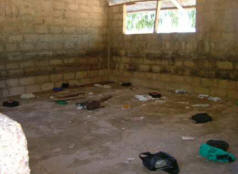
Once we had settled into our hotel
and unpacked we made the decision that our first priority would be to
visit one of the local villages and schools. We contacted one of the
more knowledgeable taxi drivers in the local area (Watamu) who made
arrangements in advance for us to visit the Mijomboni Primary School and
local village. You will see by the pictures the conditions the children
have to study in. They are in buildings that can only be described as
looking like rows of stables rather than the classrooms of some 50 plus
pupils that they really were. Each classroom as you will see by the
picture was just four walls with a roof and unstable flooring. Most of
the floors in all the classrooms were in urgent need of repair. Only two
of the classrooms had desks and chairs and they were only for the
children that were actually sitting exams. The rest of the classrooms
had no desks or seating, as you will see from the pictures the children
have to sit on the concrete floors. |
|
There were also no windows or doors that could be opened or closed, instead each just had openings that would not only let bad weather enter the room but also permit any outside noise distractions to disturb the children that were trying to study. If these problems were not enough to cope with then the rusty corrugated roofing would also allow any rain to soak through, which was obviously the reason for the concrete floors to be breaking up. We also wondered how these children were able to read or study under these conditions since there was also no electrical supplies to these buildings which obviously meant that there were no lights in place. Imagine a dark overcast stormy day which could become common place during the rainy season in the tropical location. |
 |
 |
Just before we departed the school we noticed the children dipping receptacles into a plastic bucket that contained somewhat discoloured water. When I pointed out to the headmaster that this seemed a very unhygienic way for the children to obtain drinking water and asked him why they did not have a running tap he pointed out to me that water costs money and children can be inclined to not understand this situation and can also be somewhat wasteful. |
| At this point it was put to the headmaster that if water was a problem then how did they manage to flush the toilets. We were then told that if a child needed to go to the toilet then that child also needed to obtain a receptacle of water to take with him/her to the toilet to use this as a flush. It was also pointed out to us that because of lack of funding actually reaching these outlying schools, it was a problem for a lot of the children to obtain pencils to write with or paper to write on. Having said all of this, I don’t think I have ever in the 55 years of my lifetime come across more polite and obedient children. |
 |
 |
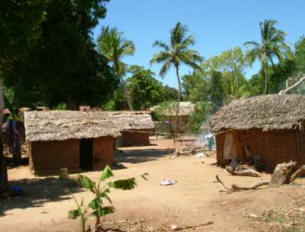
After signing the visitors book we got back in the taxi and went on our way to the village. The first thing that struck us as we reached the village was the construction of the buildings that the village people had to live in. In our western world we do our best to destroy termite nests should we find them near our properties. These villagers, on the other hand, positively encourage the termites to build their mounds. Not as you might believe to make a meal of them but because they are so importantly beneficial in the construction of their homes. These homes, the largest size we saw was probably no bigger than 4m x 4m, were made of wooden poles bound together to form squares as in a square trellis pattern that we may use for fencing. Once the panels were completed in this way they would be bound together at the corners to form the walls. |
| This is when the termite mounds became useful. Once the structure was made the material from the termite mounds would be mixed with water and set in between the squares formed by binding the wooden poles together. This mixture would set in the baking sun as hard as the clay bricks that we use for our very own homes. The roofing was no more than thatch and was also home to many of the local insect population. These structures although very strong were vulnerable during storm conditions in the rainy season. |
|
 |
Further on into the village we came across a man with his children. We asked the man how many children he had to which he replied "eight". We then asked him how old he was and he said he had no idea but did know when his birthday arrived each year. We were then led into a clearing where there was music playing and people dancing. The head man in the village brought us over something to sit on while the villagers put on a fantastic dance routine to a makeshift band. Plastic bottles were used for drums and an old piece of rusty tin was beaten with wooden twigs. The women were enchanting in their tribal dance specially put on for our benefit. Given the conditions these people are living under, no gas, electricity or running water, they remain remarkably friendly. |
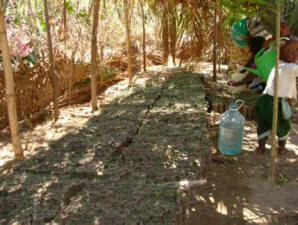
| We were then shown an enterprising project that the local forestry commission set for them. They had been shown how to take seed from certain trees and sow then in trays. Once germinated they would be transplanted on. These plants will become the material needed for the framework for their new homes. |
|
 |
Areas like these described often get overlooked or get some help then nothing more for many years. This is where organisations like The Paper Chase Trust come into the equation. They deal personally with donations by going to the locations in person. They set projects to be carried out then follow them through so there is no middle man or corrupt intervention. The amount people donate is the amount used, Shirley and Eddy, the founder members of The Paper Chase Trust, even pay their own air fare out of their pensions and stay in accommodation paid for out of their own pockets. If you would like to make a donation, how ever small, please visit www.thepaperchasetrust.org or telephone them on 01928 573664. |
The Desktopmoods team would like to thank you for taking the time to read this article.